Learning Reasoning Rewards from Expert Demonstrations with Inverse Reinforcement Learning
Abstract
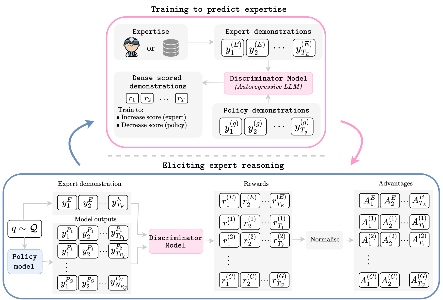
Teaching large language models to reason during post-training often relies on reinforcement learning with explicit outcome- or process-based rewards, but such reward functions can be difficult to obtain or define for complex tasks. This paper proposes Reasoning Adversarial Inverse Reinforcement Learning (R-AIRL), which learns process-level reasoning rewards directly from expert chain-of-thought demonstrations instead of imitating expert traces through supervised fine-tuning. The learned reward can be reused across the reasoning pipeline: as a post-training signal, for inference-time reranking, and for process-level diagnostics that localise reasoning failures. Across GSM8K, MMLU-Pro, and MedReason, R-AIRL improves over supervised fine-tuning in most settings, increases pass@1 through reranking by up to 17.4 points, and localises reasoning failures with up to 86.1% accuracy.